• Home
  • About Me
  • Contact Me
  • Videos
 
Blue Orange Green Pink Purple

Breeding Butterflies

Butterflies

One consequence of switching from horse to cow manure is that we have many more weeds than before, especially nettles.   We were about to mow down a patch of nettles to make some liquid compost, when we noticed that they were covered with caterpillars, which reminded me that nettles are very good breeding places for butterflies.  They are quite handsome, aren’t they, with their bright orange stripe?  I’m hoping that they will turn into something colourful and exotic looking, such as a red admiral, but I rather suspect they are large whites.  In any case, they are well worth saving the nettle patch for.  I think I’ll have to put up a sign saying “Butterfly breeding sanctuary” so that our visitors don’t jump to the conclusion that we’re too lazy to do the weeding.

Share and Enjoy:
  • Digg
  • del.icio.us
  • Facebook
  • Google Bookmarks
  • LinkedIn
  • Live
  • Twitter
  • StumbleUpon
  • Technorati
Jun 01

The Gardens at Yewbarrow House in May

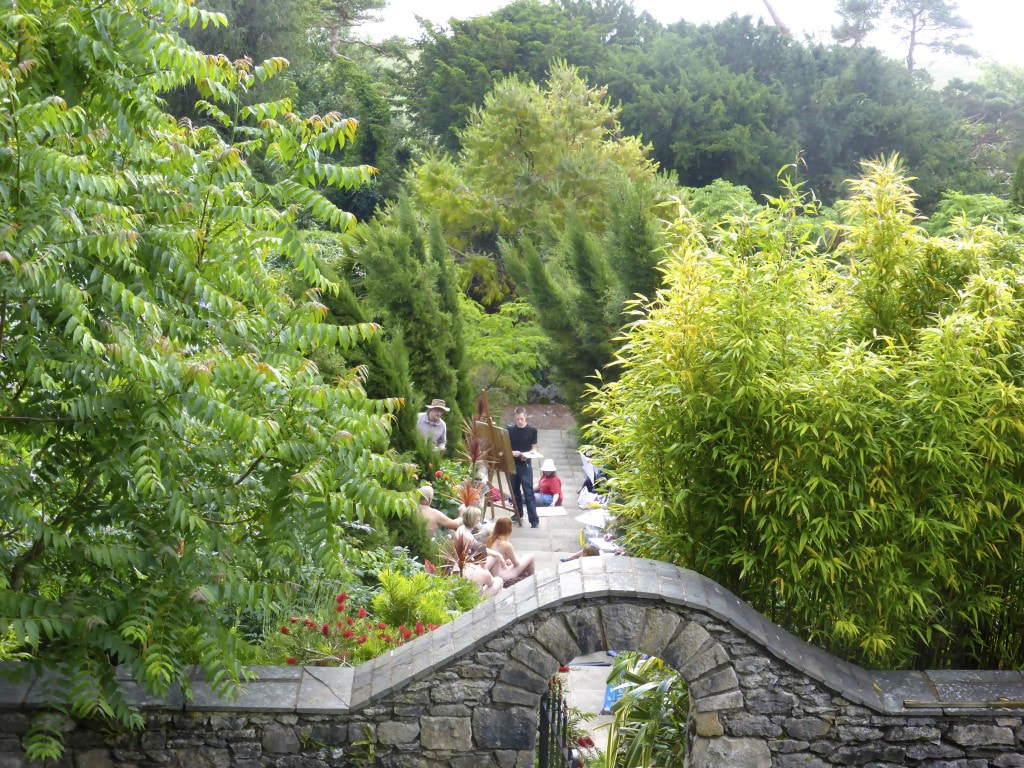
The consensus of opinion among those I spoke to who saw Christopher Bradley-Hole’s Telegraph garden at Chelsea was that it was “awful”.  It was drab, dire, derivative and, most significantly for a garden at a spring show, entirely mono-chromatic.  What Brits long for after a long hard winter is a bit of joie de vivre. Spring was so slow in arriving this year that we had the delayed gratification of seeing it all together in the month of May; daffodils with azaleas, tulips with paeonies. It was a relief to step back into my garden after Chelsea and see the colours of spring as they ought to be.  And to know that there’s plenty more to come.  Could there be anything more depressing than to open the bedroom curtains every morning, to be faced with a colourless “zen” creation in the Christopher Bradley-Hole mode?

Share and Enjoy:
  • Digg
  • del.icio.us
  • Facebook
  • Google Bookmarks
  • LinkedIn
  • Live
  • Twitter
  • StumbleUpon
  • Technorati
0 Comments
Feb 18

Sue The Bastards

I’d love to sue them myself, but I won’t be eligible as I haven’t bought anything from a supermarket in the last 8 years. But for anyone who has bought one of the “value” ranges from Tescos which they promised would be beef and turned out to be horse, there’s a great opportunity to get their own back. Tescos (and all the others for that matter) are liable in damages for misrepresentation to all those customers who they duped. How will anyone be able to prove that they bought the stuff? That’s easy if they have a Tesco loyalty card. Those cards are issued so that Tescos can keep track of everyone’s spending habits, so they will have a record of every transaction going back several years. It will be very easy to prove who bought what and when. I reckon that each pack of “value” burgers is worth at least £100 in damages. If your hungry family ate one pack a week for three years, that amounts to a tidy sum. Anyone who has been particularly revolted at the thought of eating horse should be entitled to special damages.

It really goes against the grain to suggest something which will benefit the one class of society less deserving than the supermarkets, by which I mean the legal profession, but an enterprising solicitor who was willing to bring a class action has the opportunity to make millions by suing the supermarkets. They regard a slap on the wrist from the Prime Minister as a badge of honour and they are shameless in the face of public humiliation, but a direct assault on their bank balances might just be enough to make them change their ways. Let the writs roll.

Share and Enjoy:
  • Digg
  • del.icio.us
  • Facebook
  • Google Bookmarks
  • LinkedIn
  • Live
  • Twitter
  • StumbleUpon
  • Technorati
0 Comments
Feb 17

The Garlic Smugglers


It seems almost incredible that someone has just been sentenced to jail for smuggling…garlic.  Who would have thought that such a crime existed in the 21st century?  And the poor guy’s sentence is an unbelievable six years.  That’s about what you get for manslaughter and three times the sentence for grievous bodily harm.

The miscreant was caught importing garlic from China disguised as ginger.  The reason this non-crime exists is not due to any health reasons, but that the EU subsidises garlic growers in Spain and has imposed a 9.5% tariff plus an impost of €120 euros per kilo on any imports.  The effectively shuts out all non-EU imports.  There are two consequences of this policy, apart from the ludicrously unfair penalties on transgressors.  The first is that the price we pay for garlic is about double what it would be if there was free trade.  As garlic is such a small part of our spend on food, this is too small for most people to notice.  But the second consequence is much more serious.  It means that we are denying the right of all third world garlic growers to sell their goods to us.They are much poorer than they should be as a result.  Of course, garlic isn’t the only food stuff which is penalised in this way. Most food for which EU farmers receive a subsidy is also subject to import duty.  The Economist, with characteristic understatement, described this policy as “evil”.  Just how evil, can be seen from the conflict which has recently broken out in Mali, which has involved Europe in another unnecessary war.  The staple crop in Mali is cotton, but their cotton growers are shut out from the European and US markets, leaving them in abject poverty. We should be doing everything in our power to help countries like Mali become prosperous in the only way that works in the long run, which is through trade. Instead we throw money at our already prosperous farmers and trade with the third world in machine guns.
Share and Enjoy:
  • Digg
  • del.icio.us
  • Facebook
  • Google Bookmarks
  • LinkedIn
  • Live
  • Twitter
  • StumbleUpon
  • Technorati
0 Comments
Feb 12

The Racist Effect of the War on Drugs

Who won the American election, was it Tweedledum or Tweedledee?  In terms of policy there was hardly a whisker between them, and that’s how it turned out on voting night, but when you drill down into the figures it was remarkable that Tweedledum (Ok let’s call him Obama) got 97% of the black vote, and only 39% of the white vote. But his winning margin would have been much larger if so many of the black electorate hadn’t been banged up in jail.

It isn’t really any of our business what the Americans get up to, but the size of their jail population (at well over 2 million) is one of the biggest scandals in the western world. The most scandalous  part is that more than a third of the Americans in jail are black.  One quarter of the entire young black male population is in jail. The laws in America are colour blind, but their effect is undoubtedly racist.  Young blacks get locked up because they are disproportionately poor and they take drugs.  The problem will be solved when an American President has the courage to admit that the “war against drugs” has been a much bigger failure than the wars in Iraq and Afghanistan, and at a much bigger cost to the most vulnerable. It’s ironic that the blame falls on the shoulders of a black President.

This video, by a young Professor of Economics, Daniel D’Amico, delivers the raw unpalatable facts to a political world who just don’t give a damn (in a completely non-racist way, of course).

Share and Enjoy:
  • Digg
  • del.icio.us
  • Facebook
  • Google Bookmarks
  • LinkedIn
  • Live
  • Twitter
  • StumbleUpon
  • Technorati
0 Comments
Feb 11

William Robinson – Wild about the Wild Garden

It was quite easy to get up William Robinson’s goat and one sure way was to misunderstand what he meant about the Wild Garden. It’s lucky he wasn’t able to hear Carol Klein on Great Lives saying that she loved the idea of a wild garden, just as William Robinson recommended. She was honest enough to admit that she didn’t actually know what his views were, but said that the idea of letting her garden grow wild really appealed to her. Carol Klein’s idea of a wild garden is nothing like William Robinson’s, as he repeatedly had to explain, all through his career, to his intense irritation. This is what he wrote in 1872, soon after the publication of his book ‘The Wild Garden’:

“A Lady correspondent has asked what is meant by the term “Wild Garden”, which is new to her. The Wild Garden is one where we plant, but do not mow, or rake, or trim, or stake; and wild gardening simply means the substitution of beautiful hardy plants for the weeds and brambles which cover such a comparatively large surface of ground near every country seat. It does not mean any interference with the cultivated or trimly-kept parts of the garden. It does not in any sense mean the giving of a wilder or a rougher aspect to portions of gardens designed to be “kept” in the ordinary way“.

You can sense the same feeling of irritation when he had to make the same point 36 years later, in his book on Gravetye Manor:

“The Wild Garden means the adornment of the ground away from the garden. Writers who approach the subject from the architectural side suppose that it means a new phase of gardening around the house, whereas it has nothing to do with that. It may be carried out in all sorts of positions, such as rough banks, old lawns, orchards, hollow ways and barren ground, or any suitable place in woods or along woodland rides, in any turfy or woodland situation outside the garden and away from it altogether“.

I’m sure that no-one will complain, except perhaps her nearest and dearest and anyone who might chance to visit, if Carol Klein wants to let her garden grow “wild”, but she really shouldn’t say that it was all William Robinson’s idea. The photo shows the garden at Gravetye Manor as it was in William Robinson’s day. This is the very formal garden which he saw from his breakfast room every morning.  His “wild garden” was tucked away well out of sight.

Share and Enjoy:
  • Digg
  • del.icio.us
  • Facebook
  • Google Bookmarks
  • LinkedIn
  • Live
  • Twitter
  • StumbleUpon
  • Technorati
0 Comments
Feb 03

Yorkshire Pudding with Golden Syrup

It’s not Sheila Dillon’s fault that she has a dreary voice, but it is the fault of the BBC to inflict her on us week after week on the Food Programme.  Her monotonous voice combined with relentlessly holier than thou topics make the Food Programme one of the dreariest on air.  There was hope for a livelier affair when she announced that Paul McCartney was her special guest, but all he wanted to do was to drone on about why he won’t eat meat.  But it was interesting to hear him repeat the oft-told story about why he became a vegetarian.  He said that he was enjoying a leg of lamb for Sunday lunch on his farm cooked by his wife Linda when they suddenly realised that the meat they were eating came from the lambs which they could see playing in the fields. “They’re such lovely creatures, how can we possibly eat them” is the sort of sentiment usually expressed by 12 year old girls, but Paul McCartney has no conception of the idiocy of his response and shared this recollection without the least sense of shame. A better journalist than Sheila Dillon might have asked what happened to the lambs on his farm.  Did the McCartneys  give up farming sheep, in which case what happened to the lovely green fields outside their dining room window?  Did they allow them to revert to bracken and gorse, which is what happens when sheep stop grazing fields? A bleak Sunday lunch of quorn burgers looking out onto a wilderness of bracken and gorse would have been an appropriate punishment for his sentimentality.

Did anything in the McCartney childhood presage these unfortunate events?  Sheila Dillon looked for clues by asking Paul to describe what kind of food this middle-class grammar school boy was given.  He said that every Sunday lunch he had Yorkshire pudding, as a dessert, served with golden syrup. I think this explains it all. Could anything be more perverted?  We, in the West Riding, were aware that in some parts of the country people ate Yorkshire pudding as an accompaniment to the roast beef, instead of having it on its own as a starter with onion gravy, as Yorkshire folk do, but to eat it as a dessert is odd, even for a Lancastrian.  I think this explains it all.

Share and Enjoy:
  • Digg
  • del.icio.us
  • Facebook
  • Google Bookmarks
  • LinkedIn
  • Live
  • Twitter
  • StumbleUpon
  • Technorati
1 Comment
Feb 01

Life Skills Classes

As I was driving Sara back from school today she happened to mention that one of her classes had been on the subject of “Life Skills” “What on earth’s that?” I asked “Oh”, she replied “It’s where we get told about drugs and cigarettes”. How things have changed. In my day none of the teachers did drugs and when we arrived at Uni we were completely clueless. We weren’t even given basic advice, such as how to smoke a spliff and keep on passing it round. Of course, nowadays there’s so much more to learn, with so many more drugs being available.

As for cigarettes, this is a social minefield. I’m told that the thing to do when you go to a party is to take two packs, one for yourself and one to share – the problem being that so many young people are trying to force themselves to quit smoking by not buying cigarettes that you’re constantly being pestered by people saying “You couldn’t borrow me one could you?”. The polite response is not to object either to their manners or their grammar. It’s good to think that my daughter will leave school properly taught in today’s life skills.

Share and Enjoy:
  • Digg
  • del.icio.us
  • Facebook
  • Google Bookmarks
  • LinkedIn
  • Live
  • Twitter
  • StumbleUpon
  • Technorati
0 Comments
Jan 29

William Robinson and Mandy Rice-Davies

“He would, wouldn’t he”, was the reply famously given by Mandy Rice-Davies when she was told in court that Lord Astor  had denied ever having sex with her.  But did she actually speak those words?  According to Sir Ivan Lawrence M.P. she didn’t. Sir Ivan wrote to the Times saying that he was in court, as a junior barrister, taking meticulous notes when she gave evidence and he could say with absolute authority that she didn’t.  What Sir Ivan hadn’t reckoned on was that Mandy Rice-Davies herself is still around to contradict him.  She wrote to the Times today with her riposte: “The palest ink is not always better than the best of memory, Sir Ivan – besides I have before me the court transcript”.

Poor Sir Ivan. He’s been dining out on that story for years.

Even if Mandy hadn’t been around to shoot Sir Ivan down there’s no doubt that the original story would have stuck- it’s just too good. One old chestnut which does deserve to be laid to rest was repeated on the radio today by the garden historian Richard Bisgrove in Matthew Parris’s Great Lives programme, which featured the great Victorian garden writer, William Robinson. In a discussion about Robinson’s hatred of bedding plants, Bisgrove repeated the tale that as a young man Robinson had deliberately destroyed all the plants in a heated greenhouse, by putting out the fires in the middle of winter. It’s a nice story, the only problem being that there’s no evidence that the incident ever took place, and if it did it would have had no connection with his views on bedding plants, which emerged much later. As Robinson’s biographer Bisgrove knows this, but it’s such a good story and fits in so well with Robinson’s reputation as an awkward sod that people will always say “well, he would, wouldn’t he”.

Share and Enjoy:
  • Digg
  • del.icio.us
  • Facebook
  • Google Bookmarks
  • LinkedIn
  • Live
  • Twitter
  • StumbleUpon
  • Technorati
0 Comments
Jan 24

Aaron Swartz Remembered

Aaron dead. World wanderers, we have lost a wise elder. Hackers for right, we are one down. Parents all, we have lost a child. Let us weep
Tim Berners-Lee in a tweet on learning of Aaaron Swartz’s suicide

When, last autumn, I was given a student card, after enrolling on a Master’s Degree course in Garden History, I was thrilled.  My student card would not only entitle me to half-price beer at the union bar but, equally importantly, access to all the articles which have ever been written on my subject, through JSTOR, the digital library which is free to students and out of bounds to everyone else. And then, I was given the news, which I could scarcely believe, that the JSTOR subscription of my university, Buckingham, did not extend to articles on garden history, because they couldn’t afford the charges.

This news made me very sympathetic to the campaign by Aaron Swartz, a research fellow at Harvard, for the JSTOR journals to be available free, to anyone. In pursuit of his campaign he successfully beat the best brains at MIT by downloading nearly 5 million articles from their JSTOR files, with the intention of making them freely available. This led to him being arrested and charged with offences which carried a potential penalty of 35 years in jail. JSTOR, to their credit, were willing to agree a plea bargain which would have meant that Aaron did not serve time in jail, but MIT to their shame insisted on a jail term. Which led to his suicide. Aaron had already become famous because of his role in defeating the iniquitous Stop The Online Piracy Act last year. If he had succeeded in his campaign to free the JSTOR files he would have been a hero of students everywhere, not least me. He fully deserves the tributes which he has received from the great and the good.

Share and Enjoy:
  • Digg
  • del.icio.us
  • Facebook
  • Google Bookmarks
  • LinkedIn
  • Live
  • Twitter
  • StumbleUpon
  • Technorati
0 Comments
Jan 22

Sir Roy Strong – The Laskett Legacy

Sir William Temple loved his garden at Moor Park so much that he made a provision in his will for his heart to be buried under the sundial. Which it was, when the time came, in a silver casket.

I’m not sure that Sir Roy Strong is planning to go to the lengths of Sir William in showing his devotion to his garden, but he is certainly planning his exit strategy. First to go have been dozens of conifers which had impudently outgrown their station. Next, the kitchen garden, on the very sensible grounds that there’s no point in growing things to eat if you’re not going to eat them. Sir Roy wisely pointed out that you can’t stop a garden, it moves and you’ve got to move with it. In the early days he was told off for planting trees, because “You’ll never live to see them”. “Live to see them?”, he replies “We’ve lived to chop them down!”.

Sir Roy regards The Laskett as a continual work in progress. When he arrived he was told “Remember, flowers in a garden are a sign of complete and utter failure” advice which he took to heart, because there are precious few flowers now, except in spring, but even that may change. His stonework and statuary, which was once brightly painted is taking on a terracotta hue, and he will need some colour in the borders to compensate for this.

Very modestly, Sir Roy acknowledges his debt to Hidcote and jokes that “like Horace Walpole, everything is phoney”. But he’s got his eyes firmly on the future. The Laskett has a huge archive – every week of every year – and there have been more than 40 of them – has been meticulously recorded. The archive has been bequeathed to the Bodleian, the house and garden to the National Trust, with a very handsome endowment. The ultimate fate of The Laskett will of course depend on the public, and whether The Laskett remains a favourite when the huge presence of Sir Roy is no longer there for it. Sir Edward Heath had a similar idea with his achingly beautiful house, Arundells, which had to close last year because of a lack of public support. It would be very sad if The Laskett suffered a similar fate.

Share and Enjoy:
  • Digg
  • del.icio.us
  • Facebook
  • Google Bookmarks
  • LinkedIn
  • Live
  • Twitter
  • StumbleUpon
  • Technorati
0 Comments
Jan 19

One Rule for Them…

I happened to be at the reception desk at the Newby Bridge Hotel when two officious looking men and a woman walked in. They produced badges and showed them to me. “We’re from the Food Standards Agency” one of them said “we need access to all your fridges”.

“Be my guest” I replied, trying not to look nervous. They then put on white protective over-garments and white overshoes and white hats and, looking every bit like technicians from a space lab on TV, set off for the kitchen and made themselves free with the contents of my fridges.

“We’re going to take samples of all your fresh meat, if you don’t mind” their leader said, as if I had a choice. It turned out that they had seen a sign outside my hotel advertising the fact that all my beef and pork came from rare breeds on my farm, and wanted to check if this was true.

“Has there been a complaint?” I asked. “Not at all” came the reply. “But we’re always on the lookout for claims like yours. We wouldn’t want the public to be misled”.

A few days later they came back with the result and I don’t know if they were happy, but I certainly was. Their tests proved that yes, my pork was rare-breed Middle-White and my beef was rare-breed Galloway, all of it from my farm. You can bet your life that if the results had been different they’d have had me in the Magistrates Court in a jiffy, facing a hefty fine. Small businesses like mine are easy meat for them.

Tescos on the other hand… Well, they wouldn’t dare would they. The saga of the horse meat burgers has been tremendous fun, and the jokes keep on coming. It came as something of a shock for the buyers of bargain-pack burgers to find that they contained 29% meat. Most people think they consist entirely of “pink goo” filler with added rusk. But beyond the merriment, isn’t it astonishing just how feeble the authorities in this country are being? The crime was discovered in Ireland, but it now transpires that the horse-meat had been imported from South America, via Holland. This isn’t something that can be laughed away. It’s about time those people from the Food Standards Agency donned their white coats and made some arrests.

Share and Enjoy:
  • Digg
  • del.icio.us
  • Facebook
  • Google Bookmarks
  • LinkedIn
  • Live
  • Twitter
  • StumbleUpon
  • Technorati
0 Comments
Jan 16

David Friedman

The National Liberal Club has the unfortunate distinction of being famous for its toilets. The fame arises from the story told about the habit of F E Smith of popping into the club on his way to the Commons to use their facilities. The problem was that he didn’t belong to the club and one or two of the members got a bit shirty about this and asked the porter to have a discreet word with him about it. And so, on his next visit the porter accosted him with the words: “I hope you won’t mind me pointing out sir, that this is a private member’s club?”. To which Smith retorted “Good God, is it a club as well?”

F E Smith, like his best friend Winston Churchill, was devoted to his cigars, and it was appropriate that we met tonight in the club’s Smoking Room, for a talk by David Friedman, the anarcho-capitalist and the author of The Machinery of Freedom, on the subject of ‘Law Without the State’. It was an apt reflection of just how less liberal we are now that no smoking was allowed in the Smoking Room.

One of David Friedman’s themes was the way contractual law has been changed by the internet because we are now dealing with overseas companies, such as Apple, eBay and iTunes, against whom we have, in practice, no recourse through the courts. It reminded me of a music business conference where the audience of 200 were asked if they would ever sign a contract without reading it. When everyone, including me, replied “No, of course not” we were all reminded that we dealt with iTunes every day, and no-one has ever bothered to read their terms and conditions, which amount to about 500 pages. And the same applies to Vodafone or Amazon or whoever. David Friedman said that “reputational enforcement”, ie the fear which every company has of losing its reputation, is the new means by which the customer is able to make a company meet its contractual obligations. Yes, I thought, and in my business TripAdvisor performs this function very well. I didn’t get the opportunity to ask David Friedman why Ryanair seems to be immune to this rule.

On my way out I followed the signs saying “Lavatories” to inspect the famous loos, expecting to see rows of stately porcelain urinal stalls, as in the old days. I’m sorry to say they’ve been ripped out. The whole point of the National Liberal Club went with them.

Share and Enjoy:
  • Digg
  • del.icio.us
  • Facebook
  • Google Bookmarks
  • LinkedIn
  • Live
  • Twitter
  • StumbleUpon
  • Technorati
0 Comments
Jan 13

Wearing a Helmet

Yesterday, when I was cycling along the straight bit of lane at Meathop, doing about 15mph, a hawk sprang up from the field to my left and flew alongside me for about 50 yards before swooping in front of me and away. It was one of those scarcely believable moments which will never happen again, but which doesn’t need to because I’ll never forget it.

When I got back to Grange my mood of exhilaration was dented somewhat when an elderly lady raised her arm as I passed and shouted “Where’s your helmet!”. It was the same lady who had accosted me at a meeting of the Grange Garden Society and had told me off for cycling around without a helmet. I told her that I felt much more comfortable in my cloth cap than a helmet, and that it wouldn’t be anything like as much fun if I had to wear a helmet. It was kind of her to be concerned for my safety, and her views are shared by the many who want to make it a criminal offence to ride a bike without a helmet. I believe those people are wrong. In places where cycling is ubiquitous, such as Holland, helmets are rarely worn, except by children. And in places where they have made it compulsory, such as Western Australia, bicycle usage has fallen by a third. What a pity it would be if, as a result of a well meaning law, the trend towards the greater use of cycles were to be halted, or even reversed.

Share and Enjoy:
  • Digg
  • del.icio.us
  • Facebook
  • Google Bookmarks
  • LinkedIn
  • Live
  • Twitter
  • StumbleUpon
  • Technorati
0 Comments
Jan 12

The Ever-so-Thin Empress of Blandings

It’s quite possible that Lord Emsworth first inspired me to become a pig farmer. I remember travelling by train through Italy as a teenager with only P G Wodehouse as my companion and laughing so much that the Italians called me “il pazzo Inglese”. My hero, of course, was Lord Emsworth, the batty aristo whose main aim in life was to win the “Fat Pig” category in the local show with The Empress of Blandings. And so it was natural that the first animals I bought were pigs. I went along to our local show, the Westmorland, and when a farmer from Tarporley won “Best in Show” with a Middle White sow, I persuaded him to sell me the winner’s litter. The Middle White breed is ugly, as the picture here shows, and small, as many rare breeds are (which is why they became rare).

Middle Whites never become large. The Empress of Blandings on the other hand was huge. In the books she’s a Berkshire, a breed which is much more photogenic than the Middle White. It’s a mystery therefore why the producers of the new “Blandings Castle” series have chosen a Middle White in the starring role. It’s a bit like getting Twiggy to play Hattie Jacques.

Share and Enjoy:
  • Digg
  • del.icio.us
  • Facebook
  • Google Bookmarks
  • LinkedIn
  • Live
  • Twitter
  • StumbleUpon
  • Technorati
0 Comments
Jan 11

The Damson Dene vs Claridges

A letter of complaint from a guest used to cut me to the core.  Then I read that Claridges, who are about as iconic as they get, employed someone whose sole job was to answer letters of complaint.  That cheered me up no end. If Claridges, where everything is perfect, gets moaners perhaps I shouldn’t mind so much.

Nowadays no-one ever bothers to write in.  If they’ve got something to moan about they just post something on TripAdvisor, for the world to see.  But sometimes, when things have gone splendidly, they take the trouble to tell the world about that too.  Wayne, at the Damson Dene Hotel is good at making things go splendidly. I was there every day over Christmas and New Year, but Wayne seemed to be there every hour, usually making someone laugh, with the help of his dog Fly.  Because of the rapport which Wayne has with the guests he gets lots of 5 Star reviews on TripAdvisor and in an idle moment, I thought I’d check how he has fared against the competition. Not too badly as it turns out. Last year Damson Dene got 175 five star reviews.  The iconic Claridges got only 145. When you think that Claridges has 200 bedrooms and 420 staff, whereas the Damson Dene has only 40 bedrooms and 23 staff, I think that’s pretty good going on the part of Wayne and his team.  In fact I’ve yet to find a hotel that has beaten Damson Dene.  They did better than all the other hotels in the Lake District, whatever the star rating (see link here).

I think it’s because it’s not just the staff who smile – the dog does too.

Share and Enjoy:
  • Digg
  • del.icio.us
  • Facebook
  • Google Bookmarks
  • LinkedIn
  • Live
  • Twitter
  • StumbleUpon
  • Technorati
0 Comments
Jan 11

Dividing and Storing Cannas and the Power of Rocket Fuel

With rumblings on the news about some extra cold weather heading our way we thought it would be a good idea to get our cannas out of the ground.  They can survive hard frosts if they are left in the ground and given a heavy mulch, but the only way to be sure is to dig them up and get them under cover.  The photo above shows the individual rhizomes, once they’ve been cleaned.  Each one already has two new shoots ready to develop.  We put them in pots, in compost, and keep them in a shed until February, when they can go into cold frames or into the greenhouse.  By May they will have produced a fair amount of new growth and will be ready to plant out.

The photo below shows a single plant just before digging up, with all the foliage removed.  It’s quite astonishing how it has bulked up over the last summer, even though conditions weren’t ideal for cannas.  In fact what began as 36 plants in one bed have grown so much that they now fill 140 pots, most of which have two or three plants in them.

We had two beds planted with cannas last year, one of which we mulched with horse manure and the other with cow manure.  The bed which has had the astonishing growth is the one with cow manure – or rocket fuel as we call it.  The horse manure bed, which started with exactly the same number of plants and has had identical growing conditions has only filled 40 pots – in other words the rocket fuel is three times more powerful.  This afternoon we’ve had another 15 tons of the stuff delivered – and we won’t be bothering with horse manure again.

Share and Enjoy:
  • Digg
  • del.icio.us
  • Facebook
  • Google Bookmarks
  • LinkedIn
  • Live
  • Twitter
  • StumbleUpon
  • Technorati
0 Comments
Jan 08

Set Fire to the Rain

The other day I had a call from The World at One asking if I’d like to comment, from a tourism operator’s perspective, on the news issued by the Met Office, that 2012 was officially the wettest year on record.  I replied that here in the Lake District we are not in the least intimidated by the prospect of rain, and it’s not long since that we were getting visitors from East Anglia who were coming just to be reminded what rain looked like. Rain is a part of our life here, we wouldn’t have any lakes without it, and it’s one of our great advantages that visitors aren’t at all disappointed when it happens. I was almost tempted, but managed to restrain myself, to use that old chestnut “liquid sunshine”.

But it turns out, (and why am I not surprised by this?) that the Met Office weren’t being entirely honest with us. 2012 was only the wettest year in the period since 1910, which is the period during which they have digitised records.  In fact (as Paul Simons of The Times tells us), they have records going back to 1766, and if you go that far back 2012 was only the third wettest.  The wettest was 1872. This information sent me scurrying  to my gardening magazines from that time, to see what people at the time were saying.  The ‘Cottage Gardener’ reported that “1872 has achieved the painful notoriety of being the wettest on record”.  Well put, I thought. William Robinson’s “The Garden” calculated that 50,000,000,000 tons of rain had fallen, and their correspondent from the Lake District, Mr Isaac Fletcher, the MP for Cockermouth, wrote that “the amount recorded on the Stye – nearly 244 inches – is marvellous, and is greatly in excess of any previous record”.  Robinson had published his book “The Subtropical Garden” in the previous year, which will be one reason why he is much better known now for “The Wild Garden”.

The truth is that there are huge variations in rainfall across England and the average of 33 inches in 2012 says nothing about the rainfall in any particular area.  Here in Grange our yearly average is 40 inches, so if we were to get only 33 it would be comparatively dry.  Just a few miles away in the central lakes, they get 120 inches a year – for them 33 inches would be a drought, and in Stye it would barely wet the surface.

Share and Enjoy:
  • Digg
  • del.icio.us
  • Facebook
  • Google Bookmarks
  • LinkedIn
  • Live
  • Twitter
  • StumbleUpon
  • Technorati
0 Comments
Jan 05

Killer Cats

My heart stopped when I walked into the bathroom at 4.30 in the morning and saw a large rat at my feet. The rat was frozen, as I was, and seemed to be weighing up the option of running up my leg before it darted down a hole in the corner, which had been exposed when the builders removed the shower tray, as part of our building works after the fire. Later that morning the rat man came to put down poison and the builders blocked up the hole. This unnerving experience made me sympathetic to the girls’ entreaties for us to get a cat to replace the unfortunate Pepper. Their pleas were given weight by Jennifer Dyer’s claim in the Times that her 2-year-old black and white moggy has brought her no fewer than 5 rats during 2012. She had also brought 2 bats, a grey squirrel and 122 small rodents (mice, bank voles and shrews). Creatures such as this do quite a lot of damage in my garden, as well as scaring the living daylights out of me. But what Mrs Dyer doesn’t mention is that cats have a liking for birds as well as mammals, and the chances are that her moggy caught as many small birds as she did mammals. Not such a good idea, unless you do what the Victorians used to, which is to tether them in the kitchen garden as a deterrent.

There are 8 million cats in Britain and if each of them had an equivalent haul to Mrs Dyer’s moggy, that would result in an overall kill of 1,040,000,000 (yes, more than a billion). I’ve no doubt at all that they kill an equivalent number of birds. Someone had better tell the RSPCA.

Postscript:

That Cuddly Kitty Is Deadlier Than You Think
I was amused to see this headline in the New York Times today, provoked by a  report from the Smithsonian institute that cats in America kill 2.4 billion birds and 12.1 billion mammals every year. Perhaps my estimate of a billion in the UK is on the low side after all. See here for a link to the report.

Share and Enjoy:
  • Digg
  • del.icio.us
  • Facebook
  • Google Bookmarks
  • LinkedIn
  • Live
  • Twitter
  • StumbleUpon
  • Technorati
0 Comments
Jan 02

In Memory of Pepper

There is sorrow enough in the natural way
From men and women to fill our day;
And when we are certain of sorrow in store,
Why do we always arrange for more?
Brothers and sisters, I bid you beware 
Of giving your heart to a dog to tear.

-Rudyard Kipling ‘The Power of the Dog’

Last night Pepper was lying in front of the fire, watching TV, when Sara bent down to give her an affectionate stroke.  Pepper wasn’t in the mood for petting and jumped up, biting Sara on the nose and refusing to let go.  Unbeknown to me this was the second time she had drawn blood in a matter of days – the earlier incident had involved a delivery boy’s ankle.  Pepper was a Jack Russell terrier. She had been hailed as a hero in the Daily Mail in October for raising the alarm when our house caught fire, (link) and in the annals of valiant Jack Russells came close to Sir Ranulph Fienne’s Bothie, who is the only dog to have stood on both the North and South Poles. Pepper is now no more, but we can remember her with the words of Lord Byron’s’ Epitaph to a Dog:

Oh man! thou feeble tenant of an hour,
Debased by slavery, or corrupt by power –
Who knows thee well must quit thee with disgust,
Degraded mass of animated dust!
Thy love is lust, thy friendship all a cheat,
Thy tongue hypocrisy, thy heart deceit!
By nature vile, ennobled but by name,
Each kindred brute might bid thee blush for shame.
Ye, who behold perchance this simple urn,
Pass on – it honors none you wish to mourn.
To mark a friend’s remains these stones arise;
I never knew but one – and here he lies.


Share and Enjoy:
  • Digg
  • del.icio.us
  • Facebook
  • Google Bookmarks
  • LinkedIn
  • Live
  • Twitter
  • StumbleUpon
  • Technorati
0 Comments
Dec 16

Rice Pounding

This is about as much fun as Slow Food gets.  It’s called rice pounding, which is what you do to convert ordinary sticky rice into rice cakes.  It’s possible to use a machine to make the rice cakes (or mochi, as they are known in Japan), but what the Japanese much prefer to do is to get together in the open air and pound the rice in stone mortars with wooden mallets.  They even let me have a go – I’m the sinister figure in black.  Once you have pounded the rice into a thick paste it’s whisked away to trestle tables where groups of women shape it into cakes.  The mochi are traditionally flavoured with beans or Japanese radish.  Today we’re given a special treat of a sweet soup with some of the rice balls in the bottom – just what you need after a heavy morning’s pounding.

Share and Enjoy:
  • Digg
  • del.icio.us
  • Facebook
  • Google Bookmarks
  • LinkedIn
  • Live
  • Twitter
  • StumbleUpon
  • Technorati
0 Comments
Older Entries
"The wisdom of life consists in the elimination of non-essentials"
Thoreau
  • About Slow Life

    The idea of Slow Life is to take the principles of Slow Food and extend them to life in general. Here in the Lake District where I live with my wife and three daughters, we have a garden where we grow our own food.

    We know full well that this is an inefficient and expensive way of organising our lives but we do it because we enjoy it and because it forces us to eat healthily and in season. It is slow, because gardening is all about patience.

  • Archives
    • June 2013 (2)
    • February 2013 (6)
    • January 2013 (12)
    • December 2012 (7)
    • November 2012 (10)
    • October 2012 (17)
    • September 2012 (15)
    • August 2012 (20)
    • July 2012 (17)
    • June 2012 (14)
    • May 2012 (15)
    • April 2012 (14)
    • March 2012 (17)
    • February 2012 (11)
    • January 2012 (16)
    • December 2011 (21)
    • November 2011 (17)
    • October 2011 (16)
    • September 2011 (19)
    • August 2011 (24)
    • July 2011 (17)
    • June 2011 (16)
    • May 2011 (22)
    • April 2011 (22)
    • March 2011 (18)
    • February 2011 (15)
    • January 2011 (16)
    • December 2010 (15)
    • November 2010 (14)
    • October 2010 (12)
    • September 2010 (29)
    • August 2010 (30)
    • July 2010 (15)
    • June 2010 (14)
    • May 2010 (12)
    • April 2010 (21)
    • March 2010 (13)
    • February 2010 (13)
    • January 2010 (14)
    • December 2009 (18)
    • November 2009 (16)
    • October 2009 (9)
  • Categories
    • 2011 Gardening World Cup (1)
    • Animals (3)
    • Architecture (3)
    • Arts (38)
    • Blog (5)
    • Books (43)
    • Charity (1)
    • Chelsea Flower Show (3)
    • Cooking (4)
    • Crosthwaite (1)
    • Economics (8)
    • Family (3)
    • Farm (55)
    • Film (3)
    • Food (3)
    • Garden (252)
    • Garden History (3)
    • Gardening World Cup (8)
    • Hotels (62)
    • Humour (2)
    • Interior Design (3)
    • Japan (55)
    • Language (1)
    • Magazine Articles (13)
    • Music (49)
    • Nature (19)
    • Politics (24)
    • Press (47)
    • Radio (12)
    • Restaurant (3)
    • Slow Food (69)
    • Slow Life (50)
    • South Lakes Hotels (4)
    • Sport (2)
    • Technology (7)
    • The Lake District (23)
    • Tourism (4)
    • Travel (5)
    • TV (27)
    • Yewbarrow House (46)
    • YouTube (6)
  • Links
    • Damson Dene Hotel
    • Do One Thing
    • Heroes Of She
    • High Lowscales Farm
    • Newby Bridge Hotel
    • Riverside Hotel
    • South Lakes Hotels
    • The Beekeeper's Garden
    • Yewbarrow House Garden
  • Tag Cloud
    Adam Smith Institute Alan Ward Bob Dylan Chelsea Flower Show Christmas Cumbria Dahlia Dahlias Damson Dene Damson Dene Hotel fruit Fukuoka Garden Gardening Gardening World Cup Grange-over-Sands Heroes Of She High Lowscales Farm ITV Japan Jonathan Denby Kyoto L'Enclume Lake District LHA Matt Ridley Morecambe Bay Mr McGregor's Garden Music Newby Bridge NGS pigs Riverside Slow Food Slow Life The Hotel The Lake District Tokyo Wagyu Weather William Robinson winter Yewbarrow House Yewbarrow House Gardens YouTube


© Copyright Slow Life. All rights reserved.
  • Home
  • About Me
  • Contact Me
  • Videos

© Copyright Slow Life. All rights reserved.
Designed by FTL Free WordPress Themes brought to you by [i] Website Templates

Back to Top